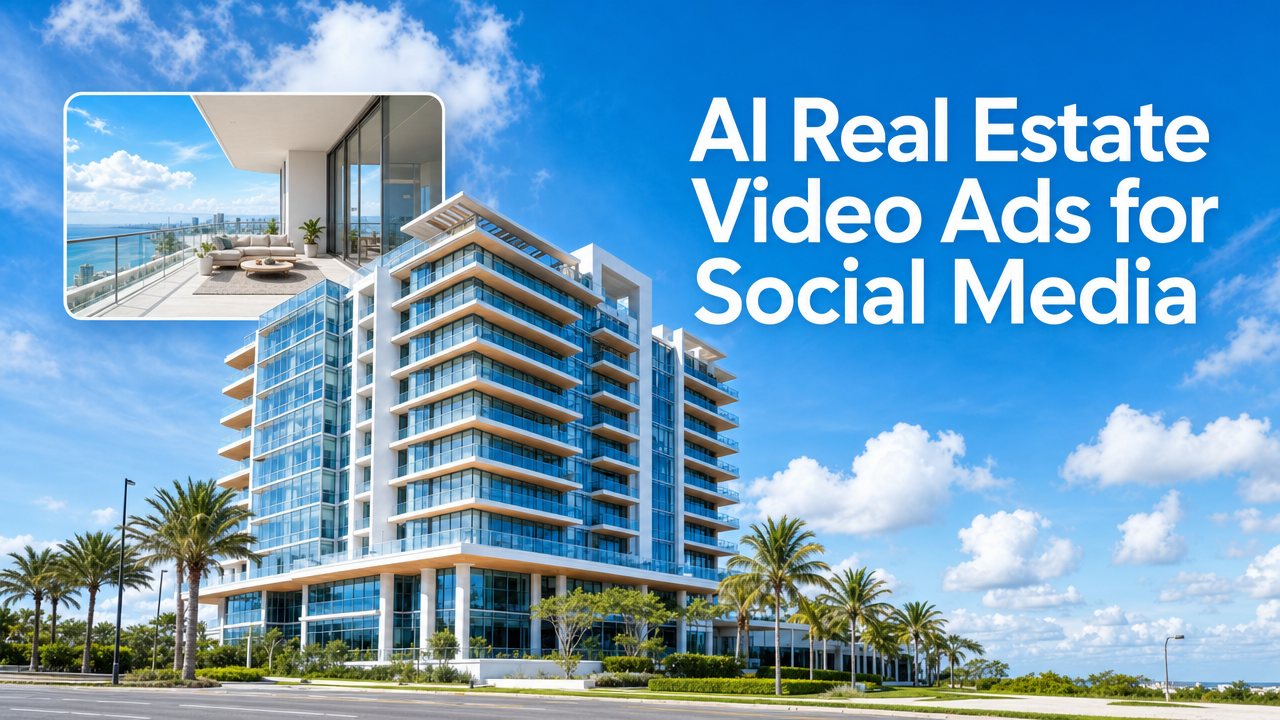
AI real estate video ads are no longer just listing-tour edits with smoother transitions. The better use case is a repeatable creative system: turn property references, listing details, local proof, hooks, voiceover, and platform formats into a set of social ads your team can review and publish without rebuilding the campaign every time.
That matters because real-estate creative has two jobs at once. It has to make a property feel specific, but it also has to stay compliant, local, and believable. A generic video generator can make a polished clip. A useful workflow helps you decide which angle to produce, which claims to avoid, and how many variants to test.
This guide expands the Videotok real-estate workflow into a practical process for agents, brokerages, property marketers, and creative teams. You will see how to move from listing inputs to short-form ads for Reels, TikTok, Shorts, Meta, and YouTube, while keeping the creative structured enough to review before it goes live.
Why AI real estate video ads need a workflow
Search results for AI real estate video ads are already crowded with single-purpose property video makers. That is a useful signal: agents and marketers are not wondering whether AI can animate listing photos anymore. They are trying to find a faster way to package property creative for social channels.
The problem is that real-estate ads do not behave like normal product ads. A house, apartment, development, or rental has constraints around location, pricing, availability, claims, fair access, and representation. The workflow has to protect the message, not only produce motion.
"Your relevance on social media as a brokerage depends on a plan that's more robust than simply posting new listings and sold listings," says Jenn Herman, social media expert at Jenn's Trends, in a REALTOR Magazine piece referenced by the National Association of REALTORS.
AI jewelry ads workflow for ecommerce teams to turn product photos into polished ad variants, test hooks, protect detail, and publish faster with Videotok.
AI jewelry ads workflow for ecommerce teams to turn product photos into polished ad variants, test hooks, protect detail, and publish faster with Videotok.
If you are planning multiple listing ads, start with a system like Videotok for real estate, then connect each property to a repeatable production pattern instead of treating every post as a blank canvas.
One listing can create several ad jobs
A single listing can become a teaser, neighborhood post, room-by-room walkthrough, investor angle, open-house reminder, agent-facing brand post, or retargeting creative. Those are different jobs. They should not share the same hook, pacing, or call to action.
The first decision is not "make a video." It is which buyer question the ad should answer. Is the viewer trying to understand the location, the layout, the price bracket, the lifestyle, the renovation potential, or the next showing window?
The asset stack matters
Most teams already have enough raw material: listing photos, floor-plan notes, website copy, drone clips, amenity images, agent footage, and neighborhood references. The gap is turning those assets into social-native variants.
Use image to video when one strong still needs subtle motion. Use slideshows when the story depends on a sequence. Use UGC-style narration when the property needs explanation rather than polish.
Compliance starts before generation
Real-estate advertising often falls into housing-related policy categories. Meta says Special Ad Categories can limit audience options for ads about housing opportunities, and Google restricts certain targeting options for housing ads in the United States and Canada.
That does not mean you cannot run creative. It means the creative brief should avoid risky targeting assumptions, discriminatory wording, exaggerated scarcity, and unsupported claims before the video is generated.
Start with one property narrative
The best AI real estate video ads are built around one narrative at a time. If you try to say "luxury", "investment", "family", "views", "neighborhood", "new construction", and "limited units" in one 15-second ad, the creative becomes brochure soup.
Pick one story. Then let the assets support it.
Choose the first three seconds
The hook is the creative control point. For a property ad, the first three seconds can be a visual reveal, a buyer question, a local contradiction, a price-context line, or a proof point.
Useful hook patterns:
"A two-bedroom that feels bigger because..."
"The view is not the selling point. This is."
"Before you book a showing, check the layout."
"This is what the listing photos do not explain."
If you need a faster first pass, use a video hook generator to create options, then edit them for the property and market. The AI should supply angles; the marketer should choose what is true.
Build a shot list before you generate
A simple five-shot structure works for most short-form property ads:
exterior or street signal
best interior proof
layout or transition moment
neighborhood or amenity cue
CTA frame
This is where AI helps most. You can ask for variants of the same property story without losing the structure: one version for a buyer, one for a renter, one for an investor, one for an open house, and one for a local audience.
Write scripts like captions, not brochures
Real-estate scripts need to sound like someone is helping the viewer decide, not like a listing description got pasted into a voiceover box. Keep sentences short. Put the concrete detail before the adjective.
Instead of "a stunning residence with premium finishes", write "The kitchen is the first proof point: wide island, hidden storage, and direct balcony light." A script generator is useful when the prompt includes the property type, audience, channel, and claim limits.
Turn listing assets into social-ready variants
One finished video is rarely enough. Social performance usually comes from a small pack of controlled variations: different hooks, crops, opening visuals, captions, and CTAs.
For real estate, the goal is not to make twenty random versions. It is to make five defensible variants that answer different objections.
Static, slideshow, and motion variants
Start with a static ad if the property image is strong and the message is simple. Use a slideshow when the viewer needs sequence: exterior, living area, kitchen, bedroom, view. Use motion video when the image has depth and the ad needs scroll-stopping movement.
Videotok supports static ads, video ads, and slideshow-style outputs in its product plans, which makes this mix practical for teams that need multiple formats from the same listing.
Brand consistency is not decoration
Real-estate creative often falls apart when every property gets a different visual language. The brand kit should set colors, typography, tone, logo use, and local proof rules before assets are generated.
Use a brand workflow to keep the property presentation recognizable across agents, listings, cities, and languages. The point is not to make every ad identical. It is to make every ad feel like it came from the same operator.
References make the AI less generic
A reference library helps the AI understand what "good" looks like for your market: vertical property reveals, agent-led explainers, neighborhood clips, amenity posts, drone openings, and testimonial-style ads.
If the team is unsure what format to test next, use a trends researcher or a curated internal board to separate temporary editing trends from durable property-story formats.
Review real-estate ads before publishing
Review is not just proofreading. For real estate, review is where creative becomes publishable.
The best checklist is short enough to use every time:
Is every claim true from the listing or source material?
Does the ad avoid implying who should or should not live there?
Is the price, availability, and CTA current?
Does the crop work in 9:16 and 1:1 if needed?
Are captions readable without blocking rooms, faces, or property details?
Does the final CTA match the platform and campaign objective?
Respect housing ad policy limits
Meta's Special Ad Category guidance says ads about housing opportunities may have limited audience selection tools. Google's personalized advertising policy says certain demographics and ZIP-code targeting cannot be used for housing, employment, and consumer finance ads in the United States and Canada.
Treat those rules as a planning constraint. Do not generate creative that depends on narrow demographic targeting to work. Make the ad valuable through the property angle, location context, and useful information instead.
Format for the platform before export
YouTube notes that the player adapts to different aspect ratios, but recommends standard 16:9 resolutions for default uploads. Short-form social usually needs vertical framing, and TikTok's creative guidance pushes advertisers to think in native, performance-led creative rather than repurposed horizontal assets.
For property ads, this means you should decide the primary format early. A living-room pan that looks elegant in 16:9 may hide the best feature in 9:16. A balcony card that works on Reels may cover too much of the image on a square feed placement, especially when you apply TikTok's creative best practices to native vertical ads.
Add an approval step for teams
Brokerages and agencies should separate generation from approval. The creator can produce variants, but someone should approve property facts, compliance notes, brand fit, and publishing copy before the ad leaves the workspace.
If your team already uses an AI production flow, pair this article with the AI social media approval workflow so legal, brand, and performance review do not happen in a messy chat thread.
Where Videotok fits in the real estate workflow
Videotok is useful when the team wants one connected creative workflow instead of a pile of disconnected tools: idea, property references, script, captions, image-to-video, slideshows, editor, brand context, media library, and social publishing.
That is why it is better to think of it as a personal creative engineer for property marketers, not a single AI video generator.
A practical production loop
For each listing, use this loop:
1. Choose the property narrative.
2. Add listing photos, references, and source details.
The most useful test is not "video A versus video B." It is hook versus hook, proof point versus proof point, CTA versus CTA, and format versus format.
For example, test "layout proof" against "view proof", or "open house reminder" against "neighborhood lifestyle". Then use the winner to guide the next production batch. The AI creative testing workflow is a natural next step once the first real-estate ad pack is live.
Conclusion
AI real estate video ads work best when they are built like a repeatable creative system, not a one-off render. The workflow starts with a property narrative, turns listing assets into controlled variants, reviews policy and brand fit, then publishes the best versions for each platform.
The real advantage is speed with discipline: more property creative, fewer messy handoffs, and clearer learning from each campaign. Start with one listing, build five variants, and use the results to sharpen the next one.
Ready to turn property references into social-ready ad variants? Start with Videotok and build your next real-estate creative workflow from one property brief.
AI jewelry ads workflow for ecommerce teams to turn product photos into polished ad variants, test hooks, protect detail, and publish faster with Videotok.